EN Capitania Alà Ke Tajà 2026 EN

Alà Ke Tajà
“And those who stayed behind in our land chose Al‑Azraq as their leader.”
JAMES I · LLIBRE DELS FEITS (BOOK OF DEEDS)
You’ve read our parchment and want to know more? This is the story of the vizier Al‑Azraq, “the Blue”: the man who defied James I the Conqueror from the mountains of our lands, and whose death now marks 750 years (1276–2026). No enemy appears in the king’s chronicle as often as he does: his nightmare. Open the chapters and find out why.
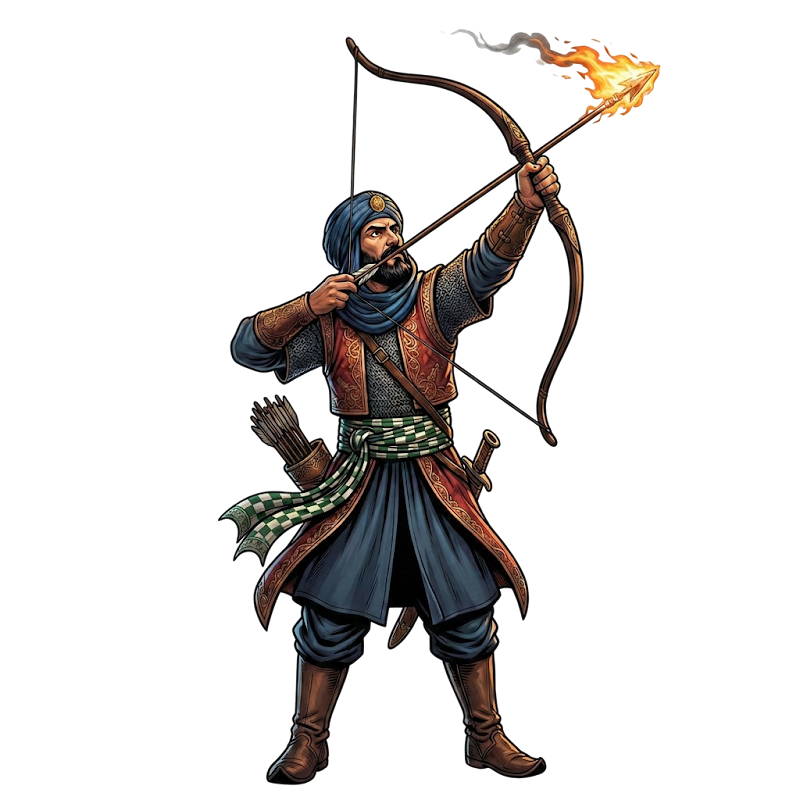
THE INTERVIEW · ALÀ KE TAJÀ’S CAPTAINCY 2026 (IN VALENCIAN)
Timeline

THE STANDARD OF THE BLUE
The vizier’s chronicle, in nine chapters
Open each chapter and read the story as told by his own enemy
IWho was “the Blue”?✦
His full name was Abu Abd Allah Muhammad ibn Hudhayl, and al‑Azraq means “the Blue”. Why was he called that? His eyes? His turban? It is all conjecture and legend: we simply do not know. In fact, nothing certain is known about him until 1245, when he first appears in the records signing the Pact of El Pouet.
Of his family we know little: his father’s lineage (Ibn Hudhayl), a brother, a nephew and a son who died before him. According to some historians, he probably held an important government post, most likely in the medina of Dénia.
II“Son alberg major”✦
His centre of power was the castle of Alcalà (also known as Benissili), at the head of the Gallinera valley. James I himself mentions it in the Llibre dels Feits as “son alberg major”: his main residence.
From there he ruled a small state of valleys and crag castles perched in the mountains, where Christian heavy cavalry could not enter and siege engines were out of the question. There were only two ways to take those castles: pact or famine.
III1244: the conquest reaches Castalla✦
After the Treaty of Almizra, in which Aragon and Castile divided up the zones of conquest, James I hurried to secure what was his: in barely a year the castles of Xàtiva, Dénia, Castalla, Biar, Benicadell and Cocentaina fell.
In September 1244, while the king’s forces marched to conquer the Biar–Castalla–Cocentaina area, the troops of Admiral Carrós and Prince Alfonso remained near Dénia, ready to push into the vizier’s domains from Pego. Our castle, the castle of Castalla, was already on the frontier of the war to come.
IVThe Pact of El Pouet (1245)✦
In April 1245, beside a small well (apud puteulum, hence the name), al‑Azraq signed a pact of vassalage with Prince Alfonso, son of James I. It was drawn up in Arabic and in Romance, and the two versions did not say exactly the same thing...
The vizier undertook to hand over part of his castles within three years, keeping others for himself and his family. But the pact was broken — and everything suggests it was not exactly he who broke it.
VThe revolt and the expulsion decree✦
In 1247 al‑Azraq took the castle of Gallinera and the revolt broke out. The king’s response was terrible: at the beginning of 1248 he decreed the expulsion of all Muslims from the Kingdom of Valencia in reprisal for the revolts led by the vizier.
The chronicle speaks of the immense crowd that gathered near Montesa to march away in the depths of winter: old people, women and children who had taken part in no revolt at all. Far from putting out the fire, the measure spread it: eleven years of guerrilla warfare through ravines and sierras the vizier knew like his own home. Because they were his home.
VIThe ambush at Rugat✦
The most extraordinary episode of all: al‑Azraq led the king to believe he wanted to become a Christian and marry a kinswoman of En Carrós. James I rode there by night with only thirty-five knights... and the vizier was waiting with seven ambushes, crossbowmen and a great clamour of horns.
The Conqueror barely escaped with his life — you can read the full quotation from the chronicle below. He never forgave him.
VIIThe diplomat✦
Al‑Azraq was not only a warrior. He wrote letters to none other than Queen Violant of Hungary, wife of James I, seeking her intercession for peace. And he negotiated with Alfonso X the Wise of Castile, the king’s son-in-law, even offering him vassalage.
His goal, according to historians: a self-governing Muslim state under Castilian protection, to resist the conquest. A chess move played between the two great Christian kingdoms — one that infuriated James I.
VIIIBetrayal and exile (1258)✦
No army ever defeated him: betrayal did. One of his closest advisers persuaded him to sell the grain stored in his castles to pay for warriors... and the Christians used the famine to break him. The king admits in his chronicle that he paid for the betrayal with 300 bezants and lands.
In the summer of 1258, al‑Azraq went into exile swearing never to return. Where did he go? It is a mystery: some place him in Granada, others in the Maghreb. Eighteen years of utter shadow.
IX1276: the last ride✦
In 1276, now an old man, al‑Azraq returned at the head of two hundred and fifty horsemen to lead a new revolt. He rode along La Canal, between Ibi and Alcoi, announcing himself to the enemy... and fell fighting before the walls of Alcoi.
His horsemen feigned retreat, the Christians gave chase, and in the Nosset ravine an ambush awaited them that almost no one survived: it has been known ever since as the Barranc de la Batalla, the Ravine of the Battle. Tradition attributed the victory to Saint George, and from all of this the Moors and Christians festivals would be born. James I died that very summer: the vizier and his nightmare departed in the same year.

Listen to the story
The vizier’s chronicle in four audio episodes, narrated and dramatised by Eugeni Mataix Albiñana (in Valencian): press play
Al-Sabil Blau
The Moorish march of the Captaincy · Marcos Pérez Herrero
Al-Sabil Blau is a Moorish march composed by Marcos Pérez Herrero for the Captaincy of Alà Ke Tajà. The title combines the Arabic al-sabil (“the path”) with the vizier al-Azraq’s nickname, “the Blue”: the life journey of the Andalusi leader, from pact to revolt and from death to legend. The piece’s structure follows the story of the boato created by Eugeni Mataix Albiñana.
♪Introduction · Al-Azraq and the Pact of El Pouet✦
The march opens with the Arab-inspired theme linked to the Blue vizier. This first episode evokes the Pact of El Pouet (1245) and introduces the thematic material that will run through the whole composition.
IAct I · The revolt of the Old Wolf of the Mountain✦
The main theme unfolds through energetic, warlike variations. It represents al-Azraq’s revolt — the Old Wolf of the Mountain — and the resistance mounted from the mountain fortresses of Valencia.
IIAct II · Defeat before James I and exile✦
A second, melancholy theme describes al-Azraq’s defeat and exile. The atmosphere turns intimate, poetically linked to his stay in the lands of Granada and to the contemplation of the Alhambra.
IIIAct III · Death and the forging of a legend✦
The transformed recapitulation of the theme represents the vizier’s return, his death before Alcoi (1276) and the birth of his legend. The theme returns in a solemn dimension, a symbol of the endurance of his memory.
The score
♫Curiosity: “Alà ke Azraq”, the fanfare✦
Marcos Pérez Herrero has also composed Alà ke Azraq: a short piece of some forty seconds for the squad’s fanfare. The title is a wordplay between the squad’s name and the vizier’s nickname.
Home ground: a war of terrain
Why no one could defeat the vizier in his mountains
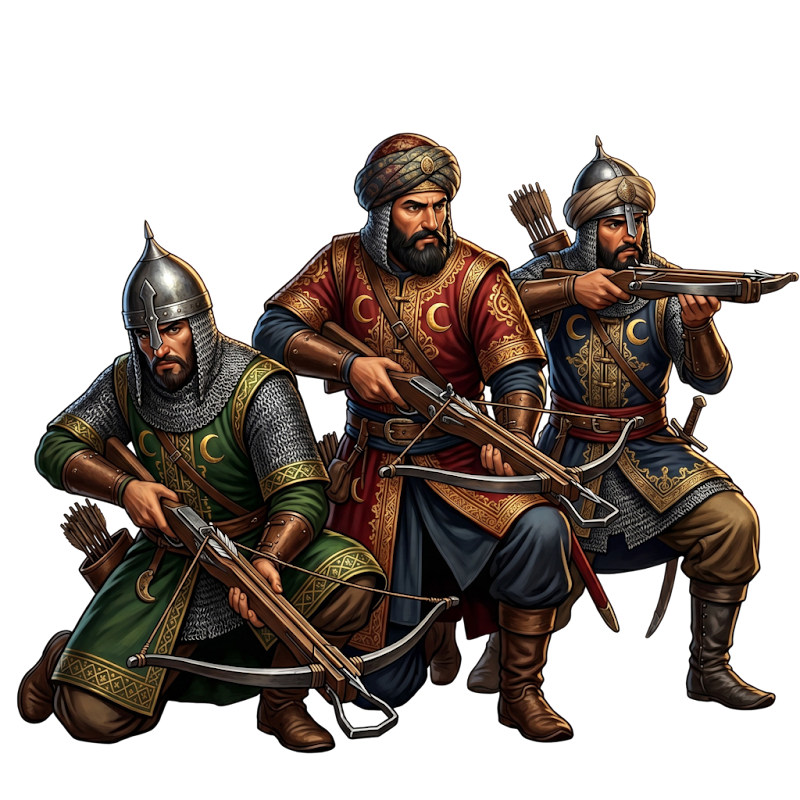
THE ARTS OF GUERRILLA WARFARE
The Llibre dels Feits is full of the combat and siege techniques of the age... but many could never be used here: the rugged terrain of our lands made heavy cavalry inadvisable, and al‑Azraq’s crag castles, perched on the rock, made it physically impossible to set up siege engines. There were only two ways to take them: a pact — the embassy we still re-enact in our festivals — or a siege that could drag on for months on end.
And that broken landscape favoured the ambush: the guerrilla arts that the Andalusis mastered like no one else, on ground they knew perfectly. It was their home.
The king versus the vizier
Thirty years of war, pacts and ambushes between the Conqueror and his nightmare
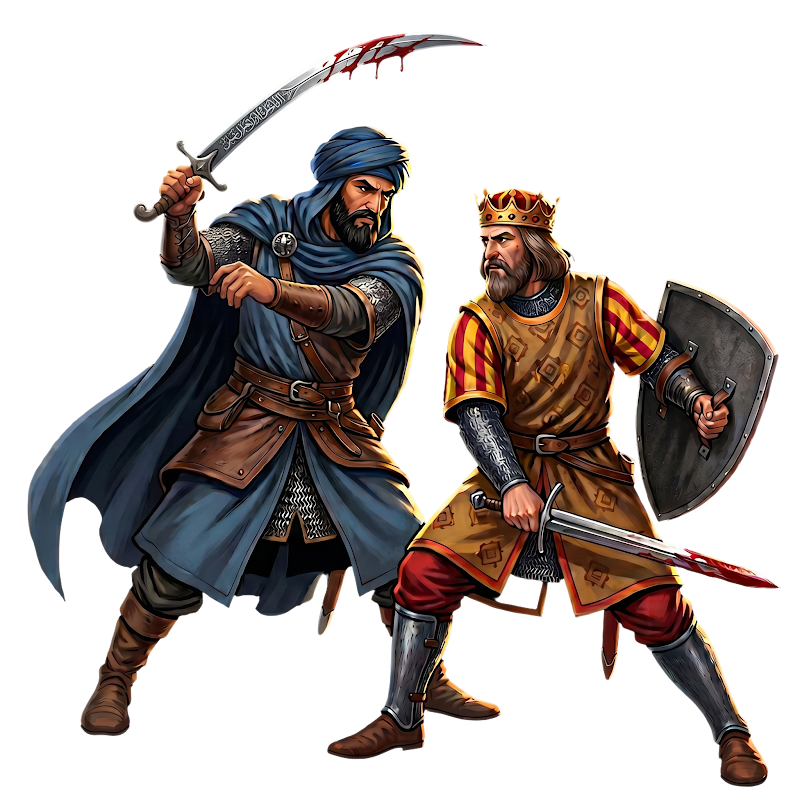
AL‑AZRAQ “THE BLUE” ✦ JAMES I THE CONQUEROR
In the king’s own words
This is how James I speaks of the vizier in the Llibre dels Feits
“...and we replied to the King of Castile that we marvelled greatly that he should ask of us a thing that was to our harm, for well he knew that Al‑Azraq had done us great evil and great damage in our land; and that he had come to us saying he wished to become a Christian and take a kinswoman of En Carrós as his wife; and as we rode by night to a Moorish castle of his called Rugat, he sought to betray us, for we were but thirty-five knights, and he tried to fall upon us with seven ambushes of Moors, with a great clamour of horns and añafil trumpets, with many crossbowmen and leather shields. And had our Lord not helped us against him, he would have slain and confounded us; and he also captured and held eighteen Christians whom we had sent there to raise a tower beyond the castle...”
LLIBRE DELS FEITS, CH. 375 · THE AMBUSH AT RUGAT“And when some two hundred and fifty of those horsemen came to Alcoi to give battle, they suffered great harm in the fight and, moreover, lost their leader, called al‑Azraq”
LLIBRE DELS FEITS · THE DEATH OF THE VIZIER, 1276The vizier’s falcon
Why a falcon on our emblem?
Falconry was the favourite pastime of the Andalusi nobility, and the falcon filled the art, the poetry and even the place names of al‑Andalus. But there is more: in Islamic tradition, the falcon symbolises the soul of the warrior. That is why a mysterious motif appears again and again in Andalusi art: a falcon perched on a riderless horse — the soul of the fallen warrior, rising to alight on the branches of the Tree of Paradise.
The falcon on our emblem is no ornament: it is the soul of the old vizier, rising above his riderless horse before the walls of Alcoi.

THE SOUL OF THE WARRIOR
AL‑AZRAQ · THE 750TH ANNIVERSARY DOCUMENTARY (IN VALENCIAN)
More videos of the blue
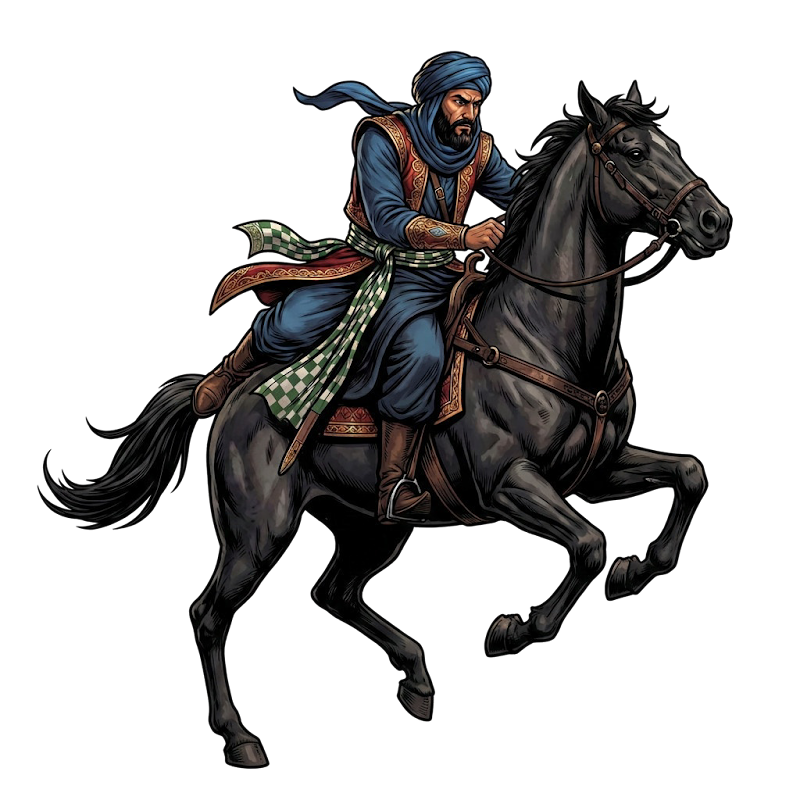 We are the Moros Vells · the Blue Moors
The oldest filà (festival company) in Castalla wears blue breeches, just as the vizier wore his name.
This year, with the 2026 Captaincy, the Alà ke Tajà squad parades
for Al‑Azraq: at the front, the vizier on horseback; behind him, his archers, riding to their last battle.
Seven and a half centuries on, this land dresses in blue for him once more.
We are the Moros Vells · the Blue Moors
The oldest filà (festival company) in Castalla wears blue breeches, just as the vizier wore his name.
This year, with the 2026 Captaincy, the Alà ke Tajà squad parades
for Al‑Azraq: at the front, the vizier on horseback; behind him, his archers, riding to their last battle.
Seven and a half centuries on, this land dresses in blue for him once more.

Comentaris
Publica un comentari a l'entrada